Minister of Defense Nakatani’s Participation in the 11th ASEAN Defence Ministers’ Meeting Plus
November 21, 2024
Japan Ministry of Defense
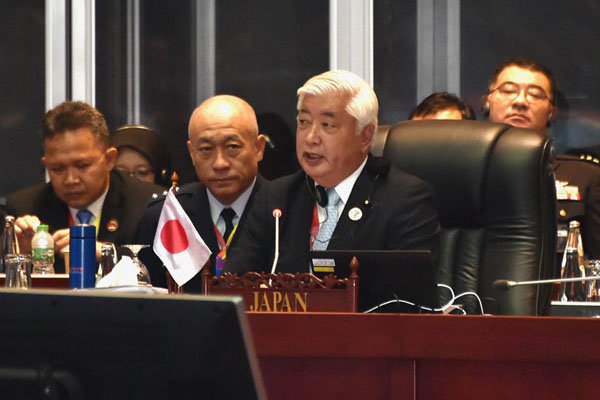
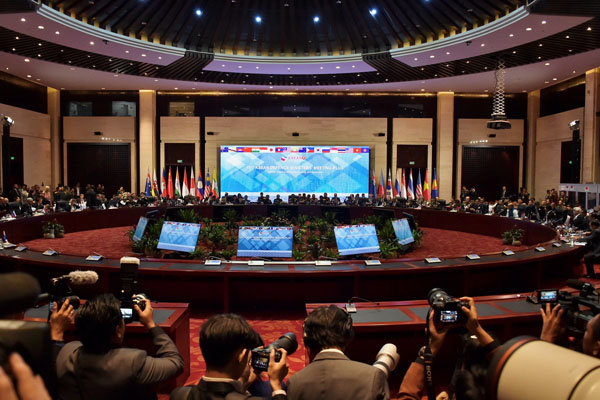
On November 21, 2024, the 11th ASEAN Defence Ministers’ Meeting Plus (hereinafter referred to as “ADMM-Plus”) was held in Lao People’s Democratic Republic (Vientiane), and Minister-level participants exchanged views on regional and international security issues. An outline of statement by Minister of Defense Nakatani, who represented Japan at the meeting is as follows:
- Minister of Defense Nakatani stressed that Japan strongly opposes unilateral attempts to change the status quo by force or coercion as well as any actions that increase tensions in the East and South China Seas. He also expressed that the peace and stability across the Taiwan Strait is important for the entire international community, and stated that Japan hopes that issues surrounding Taiwan will be resolved peacefully through dialogue.
- With regard to the deteriorating situation in Myanmar, he expressed that Japan strongly urges the Myanmar military to faithfully work towards a peaceful resolution while continuing to support ASEAN’s efforts.
- He pointed out that North Korea, in violation of relevant UN Security Council resolutions, has repeatedly launched ballistic missiles, including the recent launch of an ICBM-class ballistic missile, as well as deployment of North Korean troops to Russia last month. He mentioned Japan recognizes that the North Korean troops deployed to Russia have begun engaging in combat against Ukraine and strongly condemned the recent moves to advance Russia-North Korea military cooperation, including this recent development. He also called for continued understanding and cooperation towards the immediate resolution of the abductions issue, which is a critical issue concerning the sovereignty of Japan and the lives and safety of Japanese citizens.
- He emphasized that Russia’s aggression against Ukraine is a clear violation of international law and an outrageous act that has shaken the foundation of the international order, not only in Europe but also in Asia. He indicated that recent moves to advance Russia-North Korea military cooperation, including North Korea’s engagement in combat against Ukraine, should be a matter of serious concern as it not only leads to further deterioration of the situation in Ukraine but also affects regional security surrounding Japan.
- While underscoring that the escalation of the situation in the Middle East is extremely dangerous for the region and international community as a whole, he emphasized that all ADMM-Plus countries must urge all parties concerned to exercise the utmost restraint and call for a diplomatic resolution.
- In addition, he pointed out that non-traditional international security issues such as cyberattacks, disinformation, and the risk imposed by climate change, have become emergent.
- Then, he highlighted the importance of ASEAN principles and frameworks and expressed that Japan will continue to spare no effort in supporting various efforts under the framework of the ADMM-Plus going forward. In particular, as climate change featured in this year’s ADMM-Plus Joint Statement is an especially critical issue, he expressed that Japan will contribute to enhancing regional resilience through efforts such as capacity building and the EWGs.
- Regarding Japan-ASEAN defense cooperation, he stressed that various initiatives are ongoing under “Japan-ASEAN Ministerial Initiative for Enhanced Defense Cooperation: JASMINE”, which Japan proposed last year. He expressed his resolution to pursue further cooperation in close communication with ASEAN in line with the spirit of “Vientiane Vision 2.0.”
- Furthermore, he underlined that enhancing connectivity across regions, such as between ASEAN, Japan, and Pacific Island Countries, is essential to effectively address common issues, including climate change and disaster response. In this context, he announced that Indonesia and Japan will co-host the Maritime Cooperation and Connectivity Conference to implement the “ASEAN Outlook on the Indo-Pacific” from a defense perspective.
After the exchange of views among the participating countries, the meeting adopted the Joint Statement on Resilience to Climate-related and other Natural Disasters, including through Best Practices Exchange and Capacity-Building.
Minister of Defense Nakatani also had a defense ministerial meeting with the U.S., Australia, the Philippines, and Republic of Korea (ROK) as well as bilateral defense ministerial meetings with ROK, China, New Zealand, Lao PDR, the Philippines, India, and Brunei. They affirmed their intention to further promote defense cooperation and exchanges.