

(Provisional Translation)
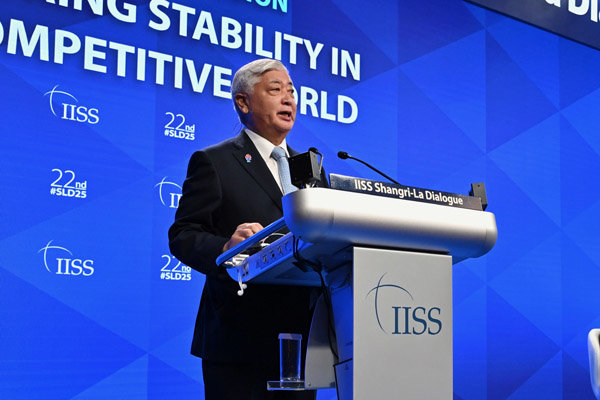
Dr. Chipman, distinguished guests, I am Gen Nakatani, Minister of Defense of Japan. At the outset, allow me to extend my deepest appreciation to the International Institute for Strategic Studies and the Government of Singapore for graciously hosting this distinguished assembly. It is my honor to share this stage with General Giang, Minister of National Defence of Viet Nam, and Her Excellency Ms. Kaja Kallas, High Representative of the European Union for Foreign Affairs and Security Policy and Vice President of the European Commission.
This marks my fourth opportunity to participate in the Shangri-La Dialogue as Japan's Minister of Defense. My first attendance was at the inaugural session in 2002, where I voiced my fervent hope that this gathering would become the preeminent and regular annual forum for defense ministers across our region to continue our dialogue.
Today, nearly a quarter-century later, the Shangri-La Dialogue has indeed become a beacon of hope in turbulent times—a forum that inspires us to forge a new chapter of success story for the Indo-Pacific. For this, I offer my profound respect and gratitude.
Today, our region and the broader international community confront challenges of an unprecedented magnitude. The need for frank and open dialogue among defense leaders has never been greater. As a participant since the very beginning, I can attest: there is no forum more fitting than the Shangri-La Dialogue for such vital discussions.
Today, competition among nations is intensifying, growing ever more complex and its impact is rapidly extending across domains.
In these times, it is incumbent upon us to address the root causes. At the heart of our current predicament lies the erosion of trust in the international order that has underpinned decades of stability. This is especially evident in the realm of defense.
First, the rules-based international order is being dangerously hollowed out. Russia's aggression against Ukraine stands as a flagrant violation of Article 2(4) of the United Nations Charter. In the South China Sea, the Arbitral Tribunal's award, which is final and binding, has been openly disregarded. Such actions threaten to undermine the very efficacy of international law, the bedrock of a peaceful and stable world.
Second, we witness a blatant disregard for accountability. In the South China Sea, a nation that once pledged not to pursue militarization has rapidly reversed course over disputed features through the reclamation of features and coral reefs. In this region, we see a rapid and opaque military buildup by a nation, including nuclear capabilities lacking transparency, and an increase in provocative military activities such as patrol and surveillance by patrol and military vessels. These developments erode trust and confidence among defense authorities.
Third, there is an abdication of responsibility for the international public good. States that do not share our values and interests are prepared to undermine the very foundations of our societies and economies for their own gain. State-sponsored cyberattacks are on the rise, and repeated damage to undersea cables—suspected to involve certain countries—has had serious implications in the field relevant to defense.
Yet, even amid these daunting realities, we are witnessing encouraging developments. Permit me to highlight five points:
First, regional frameworks are being revitalized. ASEAN's expanding role in security is particularly important, as is the continued convening of this Dialogue, which draws defense ministers from around the globe.
Second, the Japan-U.S. Alliance—and Japan itself—remains a steadfast cornerstone of peace and prosperity in the region and the world. I reaffirmed this directly with U.S. Secretary of Defense Hegseth during his recent visit to Japan at the end of March. With this robust Alliance, Japan will continue to fulfill its responsibilities for the prosperity of the region and the international community, rapidly reinforcing our capabilities as outlined in our National Security Strategy. Please place full confidence in us.
Third, countries that share common values and interests are deepening defense cooperation and creating new value together. The unprecedented collaboration among Japan, the United States, Australia, and the Philippines is a testament to this trend.
Fourth, there is a growing awareness of the dangers of excessive dependence on nations that do not share values and interests. Ensuring strategic autonomy is essential for stable defense relationships.
Fifth, interregional cooperation is flourishing. European nations and NATO are deepening their engagement in the Indo-Pacific, and it is now widely recognized that the security of the Euro-Atlantic and Indo-Pacific regions is inseparable.
Some may question whether these developments are truly encouraging. Let me be clear: they are. Here are the principles that should be once again brought to the fore.
Firstly, because they are grounded in a shared spirit—a collective commitment to restoring the rules-based international order, strengthening accountability, and advancing the international public good through cooperation, openness, inclusivity, and transparency.
Secondly, there is a shared determination among defense authorities sharing common values and interests to take a broad and panoramic view of the Indo-Pacific, to generate synergy through enhanced cooperation and collaboration, and to create new values and benefits for the entire region.
In these challenging times, it is imperative that all defense authorities in the Indo-Pacific reaffirm these points. The future of our region depends upon it.
Today, I propose that we call this emerging direction the spirit of OCEAN—One Cooperative Effort Among Nations: Perspective for the Indo-Pacific. This spirit signifies that, from an Indo-Pacific perspective, nations with shared values and interests unite to create powerful synergies through cooperative initiatives.
The term also symbolizes our vision of the Pacific and Indian Oceans as one continuous, interconnected expanse. Once again, there is no better place than the Shangri-La Dialogue to reaffirm this spirit.
Japan has always embodied the spirit of OCEAN. We will continue to take initiative and remain a partner of choice for all nations committed to cooperation and collaboration, working together for a Free and Open Indo-Pacific in the field of defense.
First, Japan is strengthening its cooperation and collaboration with countries that share this spirit. This year, I visited Indonesia and the Philippines, where we reaffirmed our shared commitment. With India, we are making tangible progress under the Japan-India Defense Cooperation in the Indo-Pacific (JIDIP), including cooperation in Southeast Asia.
Japan will continue to deepen defense cooperation—across operations, capacity building support, logistics, defense equipment and technology, as well as disaster relief and humanitarian assistance—with as many countries as possible based on shared values and interests in all areas relevant to defense.
Second, we will continue to support and collaborate with existing frameworks, and also to promote adherence to established rules. In order to uphold ASEAN unity and centrality, Japan will remain a partner of choice for ASEAN nations, supporting efforts to strengthen defense capabilities, including in non-traditional domains, under the Vientiane Vision 2.0 and JASMINE. We will also work together with all of you to promote the adherence to and strengthening of various rules, including CUES.
Third, in order to complement these initiatives, we will further strengthen collaboration among Japan, the United States, India, and Australia; Japan, the United States and Australia; Japan, the United States and the Republic of Korea; Japan, the United States and the Philippines; as well as with NATO and other key nations and organizations beyond the region.
Through these multilayered efforts in the area of defense, Japan will continue to create new values and benefits for the peace and prosperity of the Indo-Pacific, working hand in hand with all nations that share values and interests. Together with all of you, I am determined to create a new success story for the Indo-Pacific region going forward.
Now is the moment for all the participating nations in the Shangri-La Dialogue to unite in the spirit of OCEAN through continuous dialogues—not to allow the erosion of the rules-based international order, but to restore it; not to ignore accountability, but to uphold it; not to undermine the international public good, but to advance it.
Japan pledges to remain at the very heart of these efforts.
Thank you very much for your attention.