

(Provisional Translation)
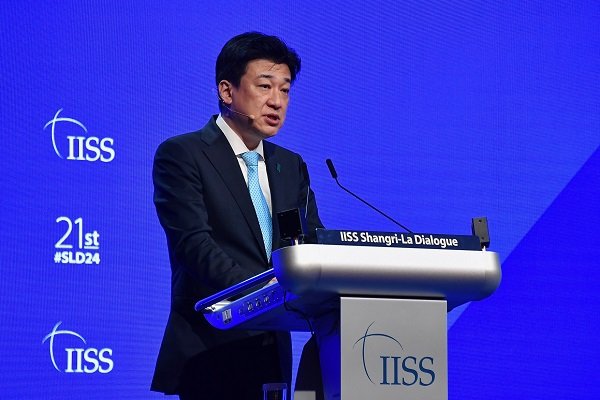
Dr. Giegerich, Dr. Chipman, Chairman Emmott, and distinguished guests, it is a great honor for me to deliver a speech at the IISS Shangri-La Dialogue. Let me express my sincere gratitude to the International Institute for Strategic Studies (IISS) and the Government of Singapore for hosting us all again.
My history with the IISS goes back to 2014, when I had the privilege of delivering remarks at the IISS in London as Parliamentary Vice-Minister of Defense.
10 years on, now at the Shangri-La Dialogue, I am greatly honored to join this session with Prime Minister Šimonytė of Lithuania and Deputy Prime Minister Attiyah of Qatar.
Today, I would like to talk about the challenges the international community currently faces, the significance of the Indo-Pacific region, and Japan’s efforts in response to these challenges.
The international community currently faces complex challenges that we have never faced before.
Russia’s aggression against Ukraine still continues, two years later. This aggression has blatantly infringed on the principles laid out in the UN Charter, such as sovereignty, territorial integrity, and the general prohibition of the use of force. The very foundation of the international order, built by our predecessors at great sacrifice, has been shaken by Russia’s outrageous act.
In the Middle East, we have been witnessing new tragedy surrounding Israel and Palestine. The protracted combat is making the humanitarian situation in the Gaza Strip increasingly dire. Furthermore, the Houthis’ attacks on civilian ships in the Red Sea and the Gulf of Aden, which are key points of maritime transportation, are seriously impeding the freedom of navigation. Japan has been continuing our diplomatic efforts to calm down the situation as soon as possible, and to improve the humanitarian situation.
In East Asia, there are also numerous challenges to the international order. North Korea has repeatedly launched ballistic missiles and others in violation of UN Security Council resolutions. Even this past week, North Korea has gone ahead with launches of ballistic missiles and others. Such actions threaten the peace and security of not only Japan, but the region and the international community. We are also witnessing unilateral changes to the status quo by force or coercion and such attempts in the East and South China Seas. Peace and stability across the Taiwan Strait is also important. Furthermore, Russia has increased its military activities in the Far East region including the Northern Territories, an inherent territory of Japan where Russia’s illegal occupation still continues.
The destabilization of regions across the world has become evident. Lamentably, over the last few years, the risk of cross-regional, simultaneous crises and inadvertent conflict has significantly increased.
While inter-state competition is intensifying, we have seen the rise of cross-border risks. Disinformation, often made by the abuse of AI technology, spreads in cyberspace and crosses national borders easily. Security issues in a broad sense, such as climate change and natural disasters, cannot be solved without cooperation on a global scale as borders mean little to these challenges.
In an increasingly interconnected world, complex and wide-ranging issues have come to the surface. These issues are crossing – or negating – borders and boundaries in terms of geography, kinetic and non-kinetic domains, and military and civilian spheres.
Facing such risks, no country can ensure its own security alone. Because we are in such an environment, we must promote cooperation beyond borders to deal with an unpredictable world.
We cannot be optimistic about the security environment in the Indo-Pacific region, where we have gathered today. In the Indo-Pacific region, one cannot rule out the possibility of a situation that could shake the very foundation of the international order.
Just as in other parts of the world, there are serious challenges in this region: military buildup without transparency; cyber-attacks on critical infrastructure; and the spread of disinformation and malicious narratives. The boundary between peacetime and contingency is becoming increasingly blurred. Economic coercion and the increasing application of influence through opaque and unfair development finance is also a cause for concern. Additionally, risks in the underwater domain, such as the intentional destruction of undersea cables, are becoming apparent.
We must not allow these challenges to be resolved through armed conflict.
Conflict in the Indo-Pacific region would incur a significant cost on every country. Prosperity in this region, where the Indian Ocean and the Pacific meet, is directly connected to the growth of the global economy. Conflict in this region would have a global impact. Supply chains would certainly be disrupted; the loss of human lives would be enormous.
It is in the common interest of the entire international community to maintain peace and stability in the Indo-Pacific region. Japan stands at the forefront of these efforts. We are determined to lead efforts to uphold and reinforce a free and open international order based on the rule of law, utilizing a network of countries that share this goal.
Under the leadership of Prime Minister Kishida, Japan is undertaking a fundamental reinforcement of defense capabilities based on its National Security Strategy, National Defense Strategy, and Defense Buildup Plan, which were formulated in 2022.
Our defense consists of three approaches. The first is strengthening Japan’s own architecture for national defense. The second approach is deterrence and response capabilities of the Japan-U.S. Alliance, which is the cornerstone of Japan’s national security and the foundation of regional peace and stability. The third is collaboration with like-minded countries and partners.
Through these approaches, Japan is working on possessing our own counterstrike capabilities, a key to deterring invasion against Japan, while we fundamentally reinforce our existing defense capabilities. And given that the risks in the cyber domain are growing increasingly severe, the Japan Ministry of Defense and Self-Defense Forces are enhancing cyber defense capabilities so that we can proactively contribute to whole-of-government efforts on cyber security. Between Japan and the United States, various initiatives are in progress, such as the establishment of a Forum on Defense Industrial Cooperation, Acquisition and Sustainment (DICAS) which is announced in the Joint Leaders’ Statement in April. Japan seeks to strengthen both our bilateral collaboration, and minilateral cooperation – such as with the United States, Australia, and the Philippines – as well as strengthen its cooperation with NATO and the EU. We continue to promote defense equipment and technology cooperation such as the Global Combat Air Programme (GCAP), for developing next-generation fighter aircraft, between Japan, the U.K. and Italy, as well as the transfer of air surveillance radar systems to the Philippines, two of which have already been delivered.
Japan’s reinforcement of defense capabilities and enhanced collaboration with its ally and like-minded countries and partners are not meant to exacerbate tensions in the region. Our intention is quite the opposite. Japan seeks to deter unilateral changes to the status quo by force in order to create a desirable security environment, while supporting countries facing aggression in violation of international law or threats of force. To these ends, Japan is taking on a greater role with its ally and like-minded countries.
To make deterrence more robust, intelligence, surveillance, and reconnaissance (ISR) is critical. Recently, disinformation and malicious narratives are constantly disseminated by foreign actors using the latest technologies including generative AI, through various channels like social media, aiming to undermine the credibility of Japan, our ally and like-minded countries. There have also been attempts to change the status quo through the use of law enforcement agencies. As the boundary between peacetime and contingency has become increasingly blurred, our ability to accurately grasp what is happening is critical. Japan puts priority on ISR that ensures seamless, continuous situational awareness at sea and in the air surrounding Japan.
Additionally, amid the complex security environment, it is vital to improve our capabilities by fully utilizing cutting-edge technologies. Japan promotes the incorporation of advanced technologies, such as surveillance with unmanned assets as well as analysis, projection of information, and support for decision making using AI.
The improvement of situation awareness capabilities is not something we do alone. With our ally and like-minded countries and partners, Japan works on enhancing regional capabilities every day.
Among Japan, the United States, and the Republic of Korea, real-time sharing of North Korean missile warning data is already in operation. We strengthen the rule of law at sea by sharing MDA (maritime domain awareness) data with countries in the region through the Indo-Pacific Partnership for Maritime Domain Awareness (IPMDA), a joint initiative of Japan, the United States, Australia and India. We support the improvement of monitoring and surveillance capabilities, for both maritime and air domains, of friendly countries through the Official Security Assistance (OSA) as well as the transfer of defense equipment and technology.
Each country monitors the sea and air, shares information, and ensures swift responses in times of emergency – enhancing such situational awareness capabilities is an integral part of peace and stability in this region, and Japan will continue to support this endeavor.
We believe that cooperation with like-minded countries and partners should be expanded beyond what we have today. Russia’s aggression against Ukraine, the situation in the Gaza Strip, and attacks on civilian ships in the Red Sea and the Gulf of Aden have demonstrated the importance of collaboration regardless of geography. For instance, between Japan and Europe including Lithuania – who is also present here today –, substantial cross-regional collaboration is growing. Cooperation on cyber and Women, Peace and Security as well as joint training with European countries are prime examples of that effort.
Of course, Japan remains committed to cooperation within the Indo-Pacific region. We continue to cooperate closely with ASEAN to support their centrality, unity, and resilience. With Pacific Island Countries, Japan promotes cooperation towards the realization of the “2050 Strategy for the Blue Pacific Continent,” respecting their centrality, unity and ownership. We also support cooperation between Japan, ASEAN, and Pacific Island Countries, and we continue to be a close partner for regional countries.
On the other hand, security cooperation between Japan and the Middle East, including Qatar who is also with us today, has untapped potential. We will promote defense cooperation and exchanges with the Middle East as well.
Japan will respond to cross-regional issues in an interconnected world and work together with friends throughout Europe and the Indo-Pacific, who share the goal of protecting peace and stability in the Indo-Pacific region and the world. Together, we will continue our endeavor to realize a Free and Open Indo-Pacific.
Standing at history’s turning point, the challenges that we must address have grown immensely. Whether the world of tomorrow will enjoy peace and prosperity or will experience more instability – the moment of truth is now.
Distinguished guests, the future will be built by us. The fate of the international order depends upon our choices. That is why Japan chooses the rule of law over the rule of force, solidarity over division, and cooperation over coercion.
Our challenges cannot be solved by one country alone.
Let’s make these choices together, and work together towards a better world.
Thank you very much for your attention.