
Naval Systems Research Center
Outline
The Naval Systems Research Center conducts research and technical evaluation of naval ships, underwater weapons, acoustic equipment, magnetic equipment, and underwater electric potential equipment.
-
Public
information video of Naval Systems Research Center
(Click the link to the ATLA Official Chanel on YouTube) - Brochure of Naval Systems Research Center(FY 2025) (PDF)
- Leaflet of Iwakuni Maritime Environment Test & Evaluation Satellite(IMETS)(PDF)
Undersea Warfare Technology Division
Research on the assessment of Anti-Submarine Warfare (ASW) and Mine Counter Measures (MCM), decision support systems for ASW, and the underwater acoustics.
Uncrewed Maritime Vehicles and Underwater Weapons Technology Division
Research on Uncrewed Maritime Vehicles(UMV), underwater weapons, and minesweeping equipment.
Naval Platform and Signature Technology Division
Research on the signature reduction of naval ships, underwater weapons, and minesweeping equipment. Field test of those prototypes and the evaluation of them.
Kawasaki Branch
Research on magnetic field and Underwater Electric Potential (UEP).
Iwakuni Maritime Environment Test & Evaluation Satellite
Research on Environment Test & Evaluation of Uncrewed Maritime Vehicles(UMV).
Research
Large Towing Tank
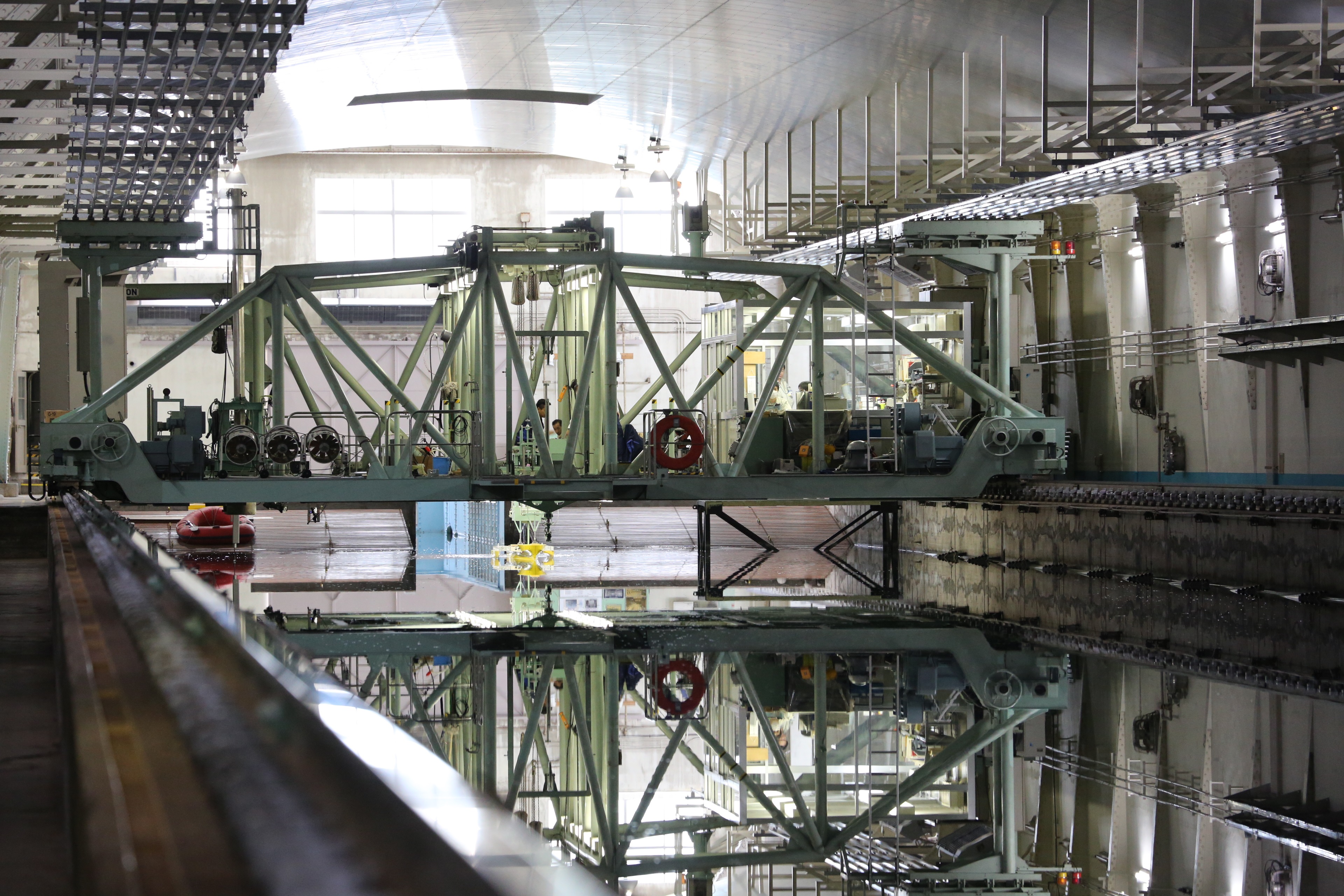
The Large towing tank is a facility to evaluate hydrodynamic performance for model ships. It is 250m long, 12.5m wide, 7m depth, and has a towing carriage runs up to 8m/s. Also it has a wave maker to conduct tests in waves. The movie below shows a measurement of ship motion of a high-speed trimaran ship in waves.
Flow Noise Simulator (FNS)
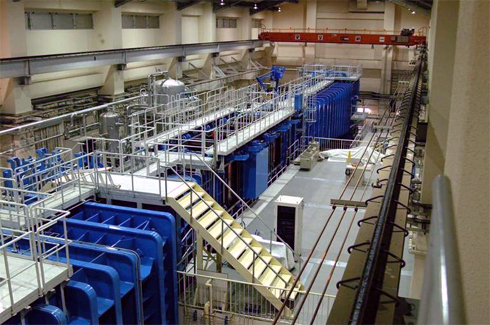
The Flow Noise Simulator (FNS) is a large circulating water tunnel with very low background noise level and enables us to evaluate both hydrodynamic and hydroacoustic properties of ships, submarines, and underwater weapons with the use of scale models or real-size ones. No other circulating water tunnel in Japan is as large as the FNS, which is one of the best circulating water tunnels in the world for its low background noise level.
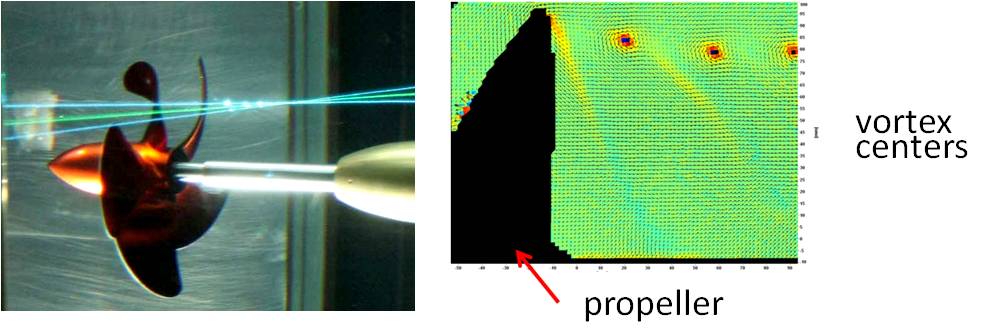
The figure at the left shows the experimental setup for the measurement of propeller flow field using a laser Doppler velocimetry. The right figure shows the simulated flow field behind the propeller model. Vortices trails from the propeller tip can be observed clearly in the right figure as red dots. In the FNS, precise flow measurements are performed by means of laser Doppler velocimetry and article image velocimetry. These results contribute to the design of noise reduced naval propellers.
Research on Improving echo sounder
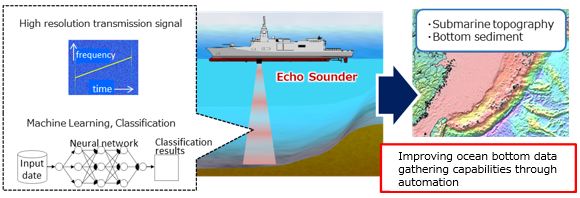
We aim to provide detailed ocean bottom data maps more quickly ever to sonar operation, by improving echo sounder installed in naval ships to functionalize automatic and high resolution detection for ocean bottom geology and topography.
Research on Multi-Purpose Combat-Support USV
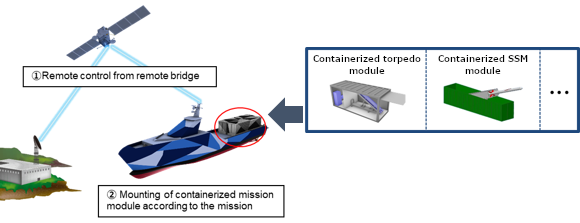
In order to realize an USV to support crewed naval vessel missions, NSRC is conducting research on the technologies for autonomous navigation that can enable the USV to navigate autonomously or be remotely controlled from a remote bridge. NSRC is also researching for realizing various functions such as surveillance and the launch of anti-ship missiles through mounting of containerized mission modules.
Improvement of electro-magnetic detection technology
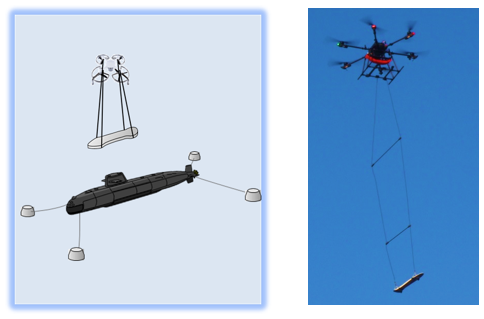
We are enhancing the technology for UAV with electromagnetic sensors to increase the detection probability of target submarines.
Research Cooperation:Australia
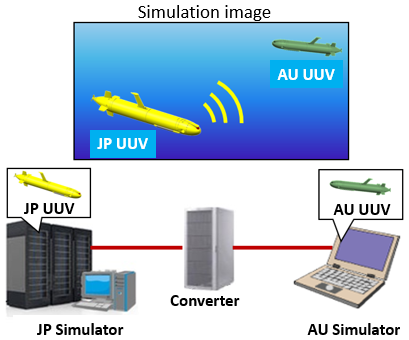
This joint research aims to establish methods for developing evaluation indices for underwater acoustic communications by connecting UUV simulators of Japan and Australia and conducting simulation with both country’s underwater acoustic communication models.
It is expected that the results of this joint research will be utilized for future interoperability of UUVs between both countries.